2026 Best SPDT Micro Switch Types for Global Buyers
Choosing the right spdt micro switch in 2026 requires more than comparing price, size, and catalog photos. Global buyers must examine electrical ratings, actuator style, terminal layout, contact material, and expected operating life. A switch that performs well in a dry control panel may fail inside a dusty machine. Small details matter.
Walter Cherry, founder of Cherry Electrical Products and a pioneer of precision switches, is often associated with this practical principle: “The switch must fit the job.” That idea remains useful today. An spdt micro switch should match the load, movement, environment, and maintenance plan. It should not be selected only because its body looks identical to another model.
This guide introduces the best spdt micro switch types for industrial equipment, appliances, automation systems, safety controls, and consumer devices. It compares roller-lever, hinge-lever, pin-plunger, sealed, high-temperature, and snap-action designs. The discussion also considers normally open and normally closed circuits, switching capacity, mechanical endurance, and installation space.
Real purchasing decisions are less tidy. A lower-cost switch may offer adequate performance, but its tolerance range can create trouble during mass production. A premium sealed model may last longer, yet exceed the project budget. That is the uncomfortable part.
Buyers should confirm test conditions, certification documents, sample consistency, and supplier support before approving a large order. Datasheets help, but hands-on evaluation exposes issues such as stiff actuation, contact bounce, loose terminals, or inconsistent reset force. No shortlist is perfect. Careful testing makes it more dependable.
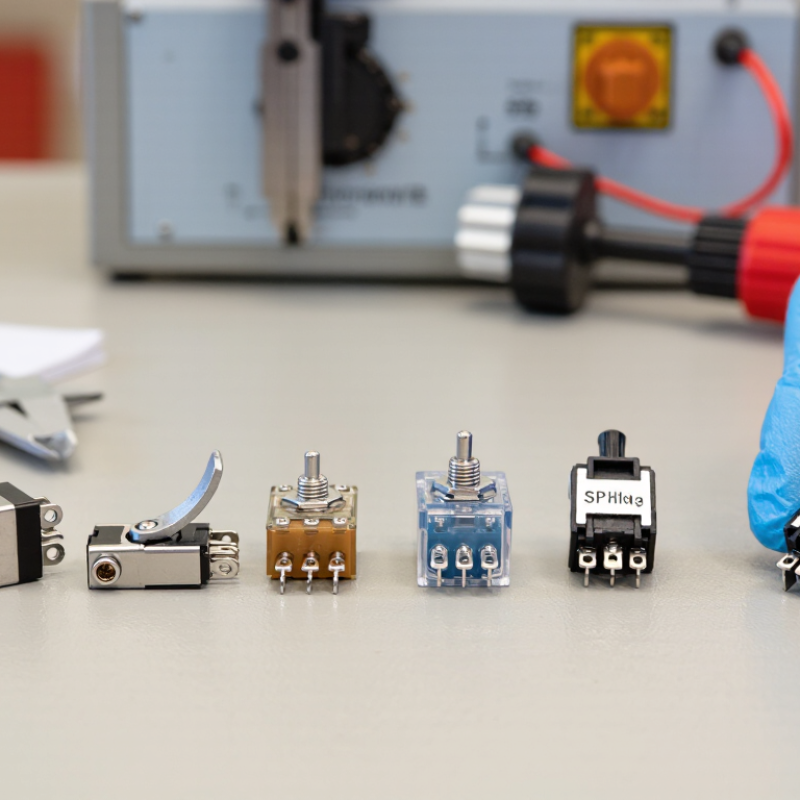
What Is an SPDT Micro Switch and How Does It Work?
An SPDT, or Single Pole Double Throw, micro switch uses one movable contact to select between two circuits. Inside, it has a common terminal, a normally closed terminal, and a normally open terminal. A spring-loaded actuator moves the contact when pressed. The movement is tiny. At rest, the common terminal connects with the normally closed terminal. When the actuator reaches its operating point, the contact transfers to the normally open terminal. Releasing the force allows the spring to return it.
This mechanism supports signal selection, position detection, and equipment control. For example, a door sensor may send a closed-state signal until the actuator moves. The same switch then sends a different signal to indicate an open position. Contact bounce can create several brief signals during switching. Engineers often control this issue through software filtering or a suitable circuit. That detail is easy to miss.
Global buyers should compare actuator style, travel, operating force, terminal layout, sealing, and electrical endurance. Plunger, roller, and lever actuators suit different movement paths. A roller type may work better against sliding motion, while a plunger fits direct compression. Confirm voltage, current, and inrush ratings under real operating conditions. A datasheet cannot predict every installation. In bench testing, even slight mechanical misalignment can cause inconsistent switching. Cost matters, but a cheap mismatch may create higher replacement costs later.
How to Compare SPDT Micro Switch Specifications
2026 Best SPDT Micro Switch Types for Global Buyers
How to Compare SPDT Micro Switch Specifications
An SPDT micro switch uses one common terminal with normally open and normally closed contacts. Compare the switching diagram, not only the product name. Check the rated voltage, current, load type, and inrush current separately. A resistive load can behave very differently from a motor or solenoid load.
Grand View Research’s 2024 Micro Switch Market report projects approximately 5.8% annual growth through 2030. This growth increases specification confusion, especially when suppliers quote different test conditions. Ask for electrical-life data at your actual load. Mechanical life alone can look impressive but may not predict field performance.
Small differences matter. Operating force affects actuator feel and mounting stress. Travel, overtravel, and release position influence reliable detection. Check insulation resistance, dielectric strength, temperature range, and terminal construction against IEC 61058-1 or IEC 60947-5-1, where applicable. Sealing claims also need test details, such as duration and water exposure.
Look closely.
For outdoor equipment, confirm the stated ingress rating and cable-entry design. For dusty machinery, a sealed housing may help, but it cannot repair poor installation. Tolerance stacking is often overlooked. A switch may meet its nominal travel while the assembled mechanism still misses the operating point. I have found that supplier drawings are useful, but sample testing remains essential. Datasheets are not always perfectly comparable.
Choosing the Right SPDT Micro Switch for Global Applications
2026 Best SPDT Micro Switch Types for Global Buyers
Choosing the Right SPDT Micro Switch for Global Applications
Choosing an SPDT micro switch starts with the application, not the catalog image. An SPDT switch can change one circuit between two outputs. Snap-action, roller-lever, plunger, and sealed types suit different operating conditions. Use a roller lever for cam-driven equipment. Choose a plunger for direct, compact movement. For dusty or damp areas, check the sealing level carefully. A familiar shape may still perform poorly under vibration.
Electrical ratings need practical verification. Confirm voltage, current, load type, contact material, and expected cycle count. Resistive loads are easier than motors or lamps. Mechanical travel also matters. A short travel may improve speed but increase alignment sensitivity. In field testing, a switch can pass bench checks and fail after repeated side pressure. That detail is often missed. Ask for dimensional drawings, test data, terminal options, and traceable quality records before purchasing. Regional documentation may also require careful review.
Tips: Match the actuator to the machine’s real movement. Leave alignment tolerance where possible. Test samples at low and high temperatures. Check packaging for moisture protection during transport. Do not rely on one successful prototype. Recheck contact bounce, mounting strength, and wire clearance. A small mismatch can create costly downtime. Feedback from installers is valuable, even when it challenges the original design.
2026 Best SPDT Micro Switch Types for Global Buyers
Choosing the Right SPDT Micro Switch for Global Applications
How to read the chart: The values show representative commonly specified contact ratings at 250 VAC for major SPDT micro switch configurations. Actual ratings vary by contact material, load type, actuator design, certification, and operating environment.
Selection guidance: Standard and roller-lever versions suit general control panels and position sensing. Sealed versions are preferable in dusty or moisture-exposed equipment. High-current versions are designed for heavier loads, while subminiature switches are useful where installation space is limited.
International Sourcing and Quality Checks for SPDT Micro Switches
2026 Best SPDT Micro Switch Types for Global Buyers
International sourcing of SPDT micro switches requires more than comparing unit prices. Buyers should confirm the switching function, actuator style, terminal layout, operating force, and travel distance. A roller actuator may suit moving mechanisms, while a pin actuator fits compact control assemblies. Small differences matter.
Request samples from each qualified supplier. Test contact resistance, insulation resistance, dielectric strength, operating force, and electrical endurance. Use the supplier’s drawings, not only catalog photographs. Check terminal plating, housing material, solderability, and actuator alignment under repeated movement. These details often reveal production weaknesses.
Reliable suppliers should provide batch traceability, inspection records, material declarations, and clear tolerance data. Independent laboratory reports can support claims, but buyers should verify their test scope and date. Confirm packaging quality as well. Moisture, loose terminals, or mixed batches can damage a shipment before assembly begins. Regional requirements may also differ, so technical and environmental documentation should match the destination market.
I have learned that a low failure rate in samples does not guarantee stable mass production. That assumption is risky. A pre-shipment inspection should include random sampling, functional testing, visual checks, and carton verification. Keep retained samples from approved batches. No checklist is perfect. Review field feedback after installation, because vibration and dust may expose problems that laboratory tests missed.