China Best Grade 304L Stainless Coils Supplier?
Choosing the China Best Grade 304l Stainless Coils Supplier? The answer requires more than comparing online prices or polished factory photographs. Grade 304l Stainless Coils are valued for their corrosion resistance, weldability, and stable performance in food equipment, chemical processing, architectural panels, and general fabrication. However, performance depends on composition, surface condition, heat treatment, and service environment.
Materials specialist James R. Davis, editor of the ASM handbook Stainless Steels, emphasizes a practical principle: “Material selection must match the service environment.” This point deserves attention. A reliable supplier should provide chemical test results, mechanical properties, coil dimensions, surface-finish details, and traceable mill certificates. Independent PMI testing can confirm chromium and nickel content before shipment. It is a small step. It can prevent expensive mistakes.
Experienced buyers should also examine production controls. Ask whether the coils meet ASTM A240 or EN 10088 requirements. Confirm whether 2B, BA, or brushed finishes are available. Check edge quality, flatness, coil weight, packaging, and loading protection. A serious manufacturer should explain its annealing process and respond clearly to welding-related questions. Vague answers are warning signs.
The cheapest offer may not be the best value. Thin packaging, mixed heats, delayed documents, or inconsistent surfaces can create problems after arrival. Even experienced purchasers sometimes focus too heavily on price. That is worth reconsidering. The strongest China supplier combines verified metallurgy, consistent production, honest communication, and dependable after-sales support. Availability matters, but evidence matters more.
What Is Grade 304L Stainless Steel Coil?
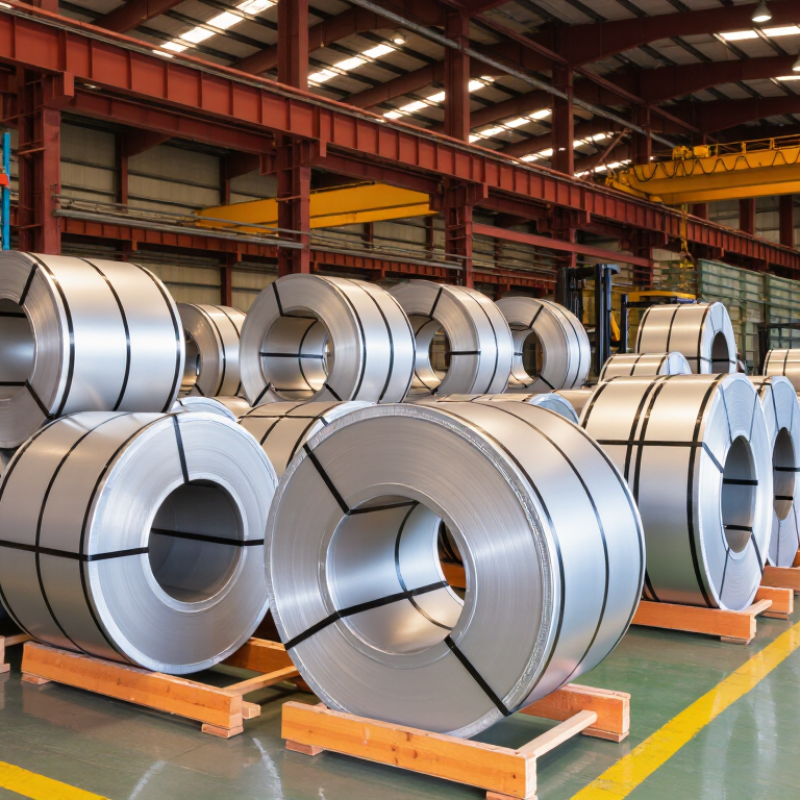
Grade 304L stainless steel coil is a flat, cold-rolled or hot-rolled strip wound for transport and fabrication. The “L” means low carbon, with carbon limited to 0.030% under ASTM A240/A240M. This reduces carbide precipitation during welding. It helps protect corrosion resistance near welded joints.
Typical 304L chemistry includes 18–20% chromium and 8–12% nickel. Its density is about 8.0 g/cm³. ASTM data lists minimum tensile strength near 485 MPa and yield strength near 170 MPa. The International Stainless Steel Forum reported global crude stainless production of about 58.4 million tonnes in 2023. That scale shows strong demand, but it does not prove every coil has equal quality. Surface finish, thickness tolerance, and heat treatment still require verification.
Tips: Request the mill test certificate, heat number, thickness tolerance, and surface grade. Check whether the coil meets ASTM A240/A240M or the project’s required standard. A simple PMI test can confirm key alloy elements. Do not rely only on a shiny surface. In practice, poor storage can create staining before fabrication, especially in humid warehouses. I have seen specifications overlook edge condition, then discover cracking during slitting. That detail deserves more attention.
How Are 304L Stainless Steel Coils Manufactured?
Manufacturing 304L stainless steel coils begins with carefully selected raw materials. The alloy contains chromium, nickel, and low carbon content. That low carbon level helps reduce carbide precipitation after welding. Scrap and ferroalloys are melted in an electric arc furnace. Argon oxygen decarburization then adjusts the chemistry with controlled oxygen and argon.
The refined steel is cast into slabs and checked for surface defects. Hot rolling reduces slab thickness through several temperature-controlled passes. The strip is then annealed to restore ductility. Pickling removes scale from the surface. Clean metal matters. Without proper pickling, later rolling may preserve stains or small pits.
Cold rolling creates the final thickness, brightness, and dimensional accuracy. The strip passes through polished rolls under measured tension. Intermediate annealing may be required when the material becomes too hard. Final annealing balances strength and formability. Leveling improves flatness before the strip is cut or recoiled. Each finished coil should receive thickness, width, surface, hardness, and chemical tests. Sampling must represent the whole coil, not only its outer turns.
In practical production, the process is rarely perfectly linear. Edge cracks, uneven tension, or scale residue can require adjustment. This is where experienced technicians make careful decisions. I would not rely on visual inspection alone. Laboratory results and traceable records provide stronger evidence of consistency. A dependable supplier should explain these manufacturing controls clearly.
What Applications Use 304L Stainless Steel Coils?
304L stainless steel coils serve demanding applications that require clean surfaces, reliable forming, and welded corrosion resistance. ASTM A240/A240M limits carbon to 0.030% maximum in 304L. This low-carbon chemistry helps reduce chromium carbide precipitation during welding. It is useful for tanks, pipework, and fabricated vessels with repeated welds.
Food-processing equipment often uses 304L coils for wall panels, conveyor parts, storage tanks, and hygienic enclosures. The smooth surface supports easier cleaning, although surface finishing and drainage matter just as much. Pharmaceutical facilities apply it to mixing vessels and cleanroom components. Chemical plants use it for mild organic acids, water systems, and atmospheric service. Conditions vary sharply. Chloride-rich environments can still cause pitting.
Architecture and transport add other uses. Coils are formed into cladding, elevator panels, kitchen equipment, rail interiors, and truck components. The World Stainless 2024 statistical report recorded approximately 58.4 million tonnes of global stainless crude steel production in 2023, showing the scale of stainless demand across construction, engineering, and consumer sectors. That figure covers all stainless grades, not 304L alone.
Heat exchangers and pressure equipment may also specify 304L, but engineers must verify temperature, chloride exposure, and code requirements. A practical selection review should include weld procedure, coil thickness, finish, and inspection records. Grade 304L is versatile, not universal. That distinction is easy to miss.
China Best Grade 304L Stainless Coils Supplier? What Applications Use 304L Stainless Steel Coils?
304L stainless steel coils are commonly used for welded equipment because their low carbon content helps reduce the risk of sensitization during welding. Typical applications include food-processing equipment, pharmaceutical vessels, chemical-processing tanks, kitchen equipment, architectural panels, piping, and general fabricated components. The chart shows representative ASTM A240/A240M chemical composition limits for 304L stainless steel, expressed as weight percentage.