How to Choose the Best Carbon Filters for Your Needs?
Choosing the right Carbon Filters starts with identifying what you want them to remove. Activated carbon can capture certain chemicals, odors, and gases through adsorption, but it does not remove every contaminant. A water filter and an air filter also solve different problems. Small details matter: a pitcher cartridge may improve taste, while a properly sized air unit may help reduce household odors. Not magic.
Before comparing products, check the exact contaminant claims and the conditions behind them. For drinking water, look for independent certification relevant to your concern, such as NSF/ANSI 42 for taste and odor or 53 for specific health effects. Certification applies only to stated claims, not every possible impurity. For air, consider the amount and type of carbon, room size, airflow, and whether the device also includes a particle filter. A thin carbon layer may have limited capacity.
Replacement schedules deserve attention. A cartridge used beyond its rated life can lose effectiveness, even when water still looks clear or an odor seems faint. Check the manufacturer’s capacity, flow rate, and maintenance guidance, then consider your household’s actual use. There is no single best filter for everyone. Product labels can be confusing, and some claims deserve a closer look. A practical choice balances verified performance, replacement cost, ease of installation, and the specific conditions in your home.
Understanding How Carbon Filters Remove Contaminants
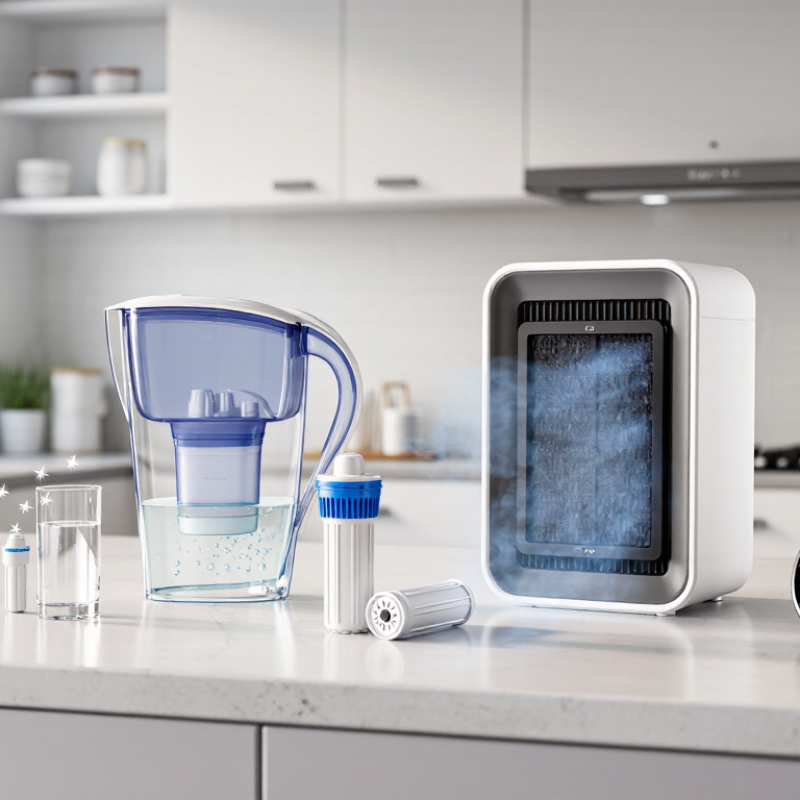
Activated carbon removes contaminants mainly through adsorption. Water passes across a vast network of tiny pores, where some dissolved chemicals attach to the carbon’s surface. Think of water moving through a dark, porous sponge. Contact time, pore size, and contaminant chemistry all affect performance. Granular carbon and carbon blocks can reduce chlorine taste and odor, and some models target specific organic chemicals. But ordinary carbon is not a universal barrier. It may not remove nitrate, hardness, or microbes.
The U.S. Geological Survey’s 2023 study estimated that at least one PFAS may be present in about 45% of U.S. tap-water supplies. That finding describes occurrence, not the performance of every carbon filter. I would not assume a filter removes a particular contaminant just because it contains carbon. Check its specific reduction claims and independent certification. NSF/ANSI 42 covers aesthetic effects, while NSF/ANSI 53 covers specified health effects. A certification applies to listed contaminants, not every possible one.
Tips: Match the filter’s certified claims to a water test or local water report. Replace cartridges on schedule; exhausted carbon can lose effectiveness. Check the fine print. A filter’s flow rate, contact time, and upkeep matter, and that last part is easy to underestimate.
Identifying the Water or Air Problems You Need to Address
Before choosing a carbon filter, identify what you need it to remove. In water, a chlorine taste, fuel-like odor, or confirmed chemical result points to different concerns. A smell is a clue, not a diagnosis. Review your water utility’s quality report, or use an accredited lab for private-well testing. The U.S. EPA’s 2024 lead service line inventory estimated about 9.2 million lead pipes nationwide. That figure does not mean every home has lead in its tap water, but it shows why guessing is inadequate. Check that a filter’s independent certification covers the specific contaminant you found; “carbon” alone is not a performance guarantee.
For indoor air, note when and where the problem occurs: cooking, painting, cleaning, or persistent odors may suggest different sources. The EPA’s “The Inside Story: A Guide to Indoor Air Quality” reports that indoor concentrations of some pollutants can be two to five times outdoor levels. Activated carbon can adsorb certain gases and odors, but it does not replace a particle filter for dust or smoke particles. Check the filter’s stated target pollutants and capacity, and replace it on schedule. A large-looking cartridge can still be the wrong match.
Keep a simple record: test results, room conditions, and when odors return. It is not glamorous, and I have found it easy to skip. Yet that small bit of evidence can prevent buying a filter for a problem it cannot solve.
Comparing Carbon Types, Filter Forms, and Treatment Capacity
Choosing a carbon filter starts with the contaminant you want to reduce, not the cartridge shape. Looks can mislead. Granular activated carbon (GAC) lets water pass through loose particles and can suit larger housings. A carbon block packs finer carbon tightly, often improving contact but slowing flow. Catalytic carbon can target certain compounds, such as chloramine, when tested for that use. Labels alone are not proof.
Form affects installation and upkeep. Fit matters. A faucet or countertop unit is convenient; an under-sink system can hold more media. Whole-house filters treat more water, yet may need larger beds and careful sizing. Match rated capacity to household use and the stated reduction claim. Capacity is not a universal number. Water chemistry, flow rate, and contact time can shorten real-world performance, sometimes substantially.
Check independent test data for the specific contaminant and exact filter model, then follow replacement intervals. An exhausted cartridge may let contaminants pass even while water still tastes normal. Keep a simple use log; it is mundane, but useful. One caveat: carbon does not reliably remove every dissolved mineral or microorganism, so test the water and choose treatment accordingly.
How to Choose the Best Carbon Filters for Your Needs?
Compare common treatment applications across carbon types. A score of 1 indicates a common application, not a guaranteed removal rate.
How to use this chart: Granular activated carbon and carbon block are commonly used for chlorine, taste, odor, and selected organic compounds. Catalytic carbon is also commonly selected for chloramine and hydrogen sulfide treatment. Powdered activated carbon is typically dosed in treatment processes rather than used as a standalone household cartridge. Actual performance and treatment capacity depend on the specific contaminant, carbon grade, contact time, flow rate, and filter design. Check contaminant-specific test results and the filter’s rated capacity before choosing.
Checking Performance Ratings, Compatibility, and Maintenance Needs
A carbon filter’s performance rating should match the contaminant you want to reduce, not just sound impressive. Check test results for the specific substance, stated flow rate, and rated capacity. A filter tested for taste and odor may not address every chemical. Ratings are conditional. Look for independent testing or a recognized standard, and read its scope; certification applies only to listed claims. Compare the replacement interval too, since capacity figures assume particular water or air conditions.
Compatibility is easy to overlook. Measure the cartridge, check the connection type, and confirm the housing’s pressure or airflow limits. For a refrigerator or countertop unit, compare the exact model number and seal shape. A loose seal can let untreated water bypass the media. For room-air systems, match filter dimensions and make sure the fan can handle the added resistance. Fit matters.
Maintenance needs depend on use, not the calendar alone. Heavy use, dusty rooms, or changing source-water quality can shorten a filter’s service life. Follow the manufacturer’s schedule, note the installation date, and replace the filter sooner if flow drops or odors return. Don’t wait for a dramatic warning. A schedule is still only an estimate; household conditions rarely match laboratory tests. A simple log can prevent guesswork.
Choosing a Filter That Fits Your Budget and Everyday Use
How to Choose the Best Carbon Filters for Your Needs?
Choosing a Filter That Fits Your Budget and Everyday Use
Start with the problem you want to address. A carbon filter may reduce certain odors and chemicals, but it does not remove every contaminant. Check the product’s performance data for the specific substances you care about. If you use a pitcher, note how many liters each cartridge is rated to treat. For a faucet or whole-home system, compare flow rate and replacement costs, not just the initial price. Small print matters.
Think about your routine. A compact pitcher can suit one person with limited counter space, while a larger household may prefer a filter with greater capacity. A low-cost unit can become expensive if its cartridges need frequent replacement. Check availability and price before buying, and follow the maker’s replacement schedule. A filter used past its rated capacity may perform poorly. Still, household water and usage vary, so advertised capacity is only a guide.
Tips: Write down your usual weekly water use and set a monthly filter budget. Compare the total first-year cost, including replacement cartridges. Look for independent test information that matches your needs. If the numbers feel confusing, they sometimes are; ask the supplier what was tested, and keep the answer for reference.