How to Choose the Best Glasgow Mobility Scooters?
Choosing a scooter in Glasgow is not just a matter of comparing prices or advertised range. Hills, uneven pavements, rain, and limited storage can change which model works in everyday life. The WHO and UNICEF Global Report on Assistive Technology (2022) estimates that 2.5 billion people need at least one assistive product worldwide. That figure highlights why access and practical fit matter, though it cannot tell you which scooter suits a particular person.
This guide to Glasgow Mobility Scooters will help you compare essential features, including portability, battery range, comfort, turning space, and local servicing. A compact scooter may fit neatly into a car boot but feel less stable on longer journeys. A larger model may offer a more comfortable seat, yet prove awkward in a narrow hallway. Small details count. Before choosing, consider the routes you actually use, where the scooter will be stored, and whether a nearby supplier can arrange a hands-on assessment. Ask about demonstrations, warranty cover, and replacement batteries, and verify specifications with the manufacturer. Published range figures are usually based on test conditions, so real-world performance can differ with rider weight, temperature, terrain, and battery condition. I would not treat a comparison table as the whole answer. It is a useful start, but personal comfort and a realistic test drive may reveal something the numbers miss.
Understanding the Main Types of Mobility Scooters in Glasgow
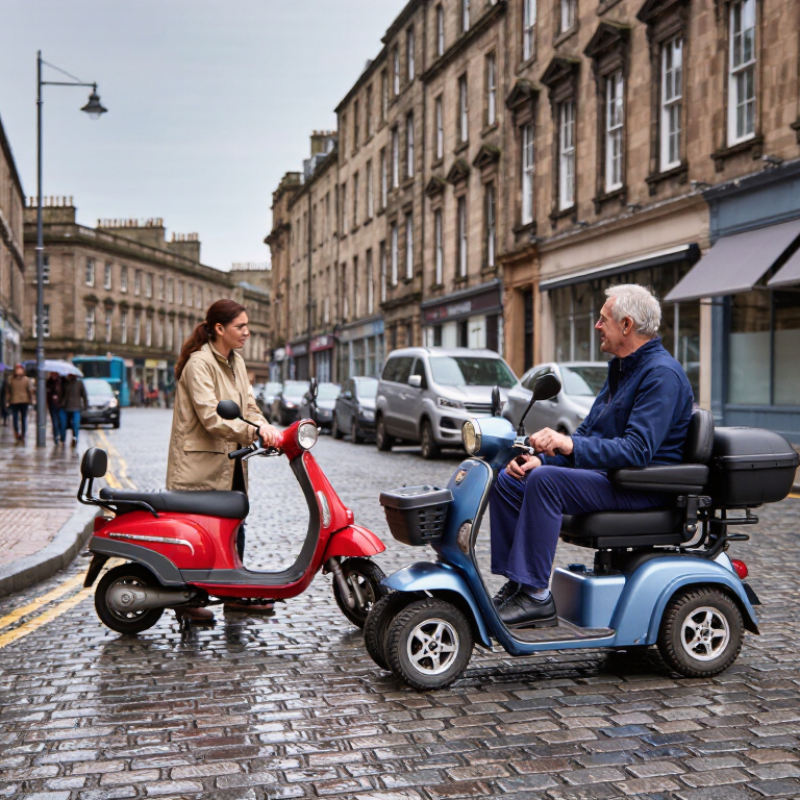
Glasgow’s pavements, hills and frequent rain make scooter choice a practical decision, not just a question of appearance. Compact folding scooters suit car journeys and indoor errands; their smaller wheels and shorter range can feel less steady on uneven paving. Three-wheel models turn neatly in shops, while four-wheel scooters usually offer greater stability and roomier seating. Try turning, stopping and mounting a kerb safely before deciding. A showroom floor is not Glasgow.
Class 2 scooters are limited to 4 mph on pavements; Class 3 models can travel up to 8 mph on roads and 4 mph on pavements under UK guidance. Class 3 options may suit longer outdoor trips, but check storage, charging access and route conditions first. The World Health Organization’s 2022 Global Report on Assistive Technology estimates that 2.5 billion people need one or more assistive products worldwide; this figure covers many devices, not scooters alone. That matters. For a local choice, compare the scooter’s stated range with your actual route, including hills, passenger weight and battery age. I would still test it outside. Specifications rarely capture how a wet slope or tight close entrance feels.
Assessing Your Mobility Needs and Everyday Travel Routes
Choosing a mobility scooter in Glasgow starts with your actual week, not a brochure’s maximum range. List the places you visit regularly, such as a nearby shop, GP surgery, or bus stop. Note the distance, surfaces, and how often you travel. A short journey can still be tiring if it includes a steep approach or several stops. Consider how long you sit, whether you need room for shopping, and whether the scooter must fit inside your home. Small details matter. Seat comfort and easy controls may be more useful than extra speed.
Look closely at your everyday routes. Check for uneven paving, narrow doorways, dropped kerbs, busy crossings, and slopes. Glasgow’s rain can make some surfaces slippery, so think about grip and weather protection. If possible, test a scooter on a route similar to one you use often. Include the return journey; battery estimates may change with hills, load, and temperature. It is easy to overvalue range. Measure storage space and any lift before choosing, and consider how you will charge the scooter. An occupational therapist or experienced mobility adviser can help assess fit and safe handling. Your first route plan may miss something; revise it after a real trial.
Comparing Range, Comfort, Size, and Accessibility Features
A useful Glasgow mobility scooter should match the journeys you actually make, not just look impressive on paper. Check the stated range, then allow for hills, frequent stops, colder weather, and the weight being carried. These can reduce how far a scooter travels between charges. I would treat any published range as an estimate, not a promise. That matters.
Comfort shows up after more than a short showroom ride. Sit in your usual coat and check whether your knees have room, your feet rest naturally, and the tiller feels easy to reach. Try a gentle turn and a stop. If possible, test the scooter on uneven paving; Glasgow’s surfaces can make small wheels feel less forgiving. A plush seat helps, but it cannot fix poor posture or awkward controls.
Size involves a trade-off. A compact scooter may be easier to store and manoeuvre through narrow doorways, while a larger model can feel steadier outdoors. Measure your storage space and the tightest doorway on your regular route. Then check practical accessibility features, such as adjustable seating, clear controls, lights, and enough ground clearance for kerbs. Try it outdoors. Also confirm how it can be transported, because a scooter that suits the pavement may not fit your car or building entrance. I would not assume one model can do everything well.
Checking Local Suppliers, Demonstrations, and After-Sales Support
When comparing Glasgow mobility scooter suppliers, look beyond the showroom price. Ask whether staff will assess your usual routes, including sloped pavements, kerbs, and tight shop entrances. A short indoor test can miss important problems. Try it outdoors.
During a demonstration, check that you can transfer onto the seat, reach the controls, turn comfortably, and stop smoothly. Bring a coat or bag you normally carry; small changes in weight can affect storage and handling. Ask to test the scooter on a surface similar to your regular route. One demo cannot reproduce every Glasgow street, so note what still feels uncertain.
After-sales support matters as much as the initial fitting. Ask how repairs are arranged, whether replacement batteries are available, and what the warranty excludes. Get expected response times in writing, especially if you depend on the scooter for daily journeys. The World Health Organization and UNICEF’s 2022 Global Report on Assistive Technology estimates that 2.5 billion people need one or more assistive products, with that number projected to reach 3.5 billion by 2050. That wider need makes dependable servicing worth checking carefully. A friendly conversation is helpful, but it is not a repair plan. My own judgement could still be wrong: local service coverage may change, so confirm details before buying.
Reviewing Costs, Safety Requirements, and Ownership Options
A Glasgow scooter’s purchase price is only part of its cost. Compare written quotes for delivery, servicing, batteries, and repairs; battery replacement can change the value of a second-hand model. Hire may suit a short recovery period, while buying can make sense for frequent journeys. Some users may qualify for support through mobility schemes, but check eligibility and contract terms before committing. Small print matters.
Safety starts with choosing the right class. UK Department for Transport guidance sets Class 2 scooters at a maximum 4 mph, while Class 3 models can reach 8 mph on roads and 4 mph on pavements. Class 3 scooters must be registered with the DVLA. These figures are limits, not recommended speeds for every street. Test it outdoors. Try Glasgow’s sloped pavements, tight shop entrances, and rough surfaces before deciding. Check turning space, lights, brakes, seat comfort, and whether the scooter fits your home or car. A model that looks ideal in a showroom may feel awkward on a wet, crowded pavement. I would not assume the biggest battery is best; extra range can mean more weight and harder storage. Ask a qualified dealer to demonstrate safe transfers and charging, then compare ownership costs with hiring.