
Automated Dispensing Robot Videos

A World of Robotic Dispensing and Assembly Solutions

Why Choose PVC Layflat Hose for Water Transfer?

Moving water efficiently is a practical challenge for farms, construction sites, drainage crews, and emergency teams. The United Nations World Water Development Report 2024 notes that agriculture accounts for about 70% of global freshwater withdrawals. That figure puts everyday water delivery under real pressure. The right hose can help reduce handling time and keep water moving across uneven ground, though it cannot solve poor planning or supply shortages.

A Pvc Layflat Hose is designed to stay compact when empty and expand under water pressure. Its flat profile makes storage and transport easier than with many rigid pipes. Crews can unroll it beside a field, connect it to a pump, and route it around equipment or muddy patches. These features make it useful for temporary water transfer, irrigation support, and site dewatering. Yet performance depends on hose diameter, pressure rating, fittings, water conditions, and careful handling. A kink near a pump outlet can slow flow. A sharp stone can damage the outer cover. Small details matter.

FAO’s AQUASTAT resources provide country-level information on water use and irrigation, helping readers understand why transfer systems must suit local conditions. But published water-use figures do not prove that one hose type is best everywhere. Buyers should compare technical specifications and inspect the hose before use. PVC layflat products can offer a practical balance of portability and flow capacity, but the choice deserves a closer look.
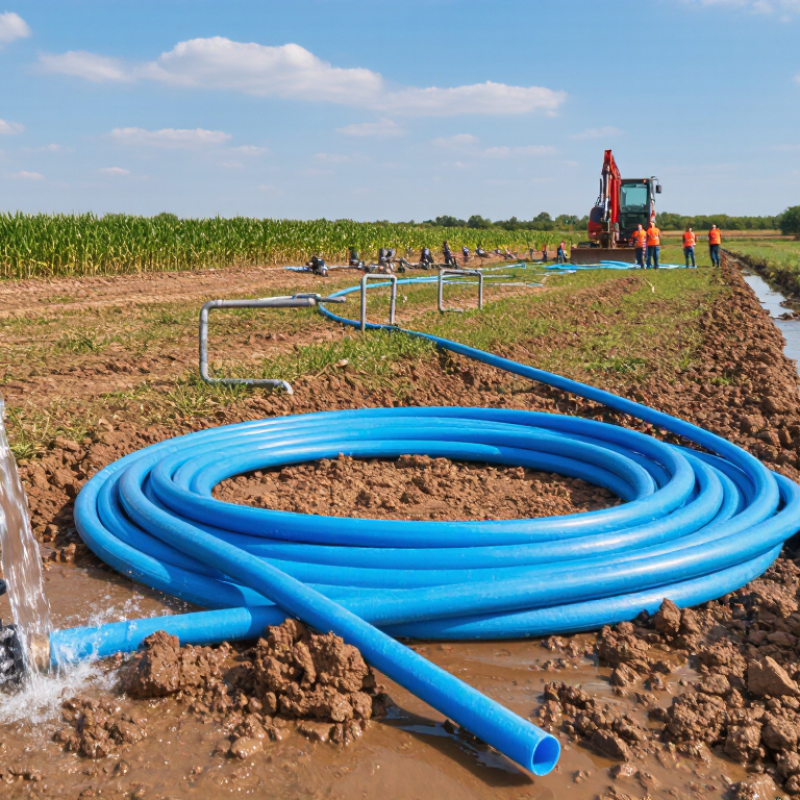
Why Choose PVC Layflat Hose for Water Transfer?

What Is a PVC Layflat Hose?

A PVC layflat hose is a flexible tube designed to carry water and flatten when it is empty. Its walls are commonly made from PVC, with woven polyester reinforcement inside. The PVC helps contain the water, while the textile layer adds strength. Construction varies, so check the hose specifications rather than assuming every model performs the same way. That matters.

Unlike a rigid pipe, a layflat hose can be rolled or folded for transport. When connected to a pump, it opens under water pressure and forms a broad, flat line. On a work site, this can make long runs easier to move and store. The term “layflat” sounds simple, but a full hose can still be heavy and awkward to reposition.

For water transfer, match the hose’s rated working pressure and diameter to the pump and application. Keep it away from sharp edges, and avoid dragging it over rough gravel when possible. Inspect the cover and fittings for cuts, wear, or loose connections before use. A damaged area may worsen under pressure. PVC layflat hose is practical, but it is not a substitute for checking pressure limits or handling instructions.

How Is a PVC Layflat Hose Made?

A PVC layflat hose begins with two jobs: carry water and resist pressure. Manufacturers typically weave high-tenacity polyester yarn into a flexible tubular jacket. PVC compound is heated, then extruded or coated over the reinforcement to form a water-resistant wall. Some designs use a separate inner liner. The exact sequence varies, but bonding matters: weak adhesion can cause layers to separate during repeated folding.

The material choice is widely used. PlasticsEurope’s Plastics – the Fast Facts 2023 reports 400.3 million tonnes of global plastics production in 2022, with PVC accounting for 12.4%. That figure describes the broader plastics market, not hose output.

After coating, makers check dimensions, layer adhesion, and pressure performance against the hose’s stated rating. Samples may also undergo burst testing. The process sounds tidy on paper; keeping coating thickness even along a moving hose is less forgiving.

Tips

Check that the yarn reinforcement is evenly distributed and the coating has no bare spots. Match the working-pressure rating to the pump and water system. A useful detail: store the hose dry and loosely coiled; tight bends can stress the same areas repeatedly.

How Does It Transfer Water?

Why Choose PVC Layflat Hose for Water Transfer?

How Does It Transfer Water?

A PVC layflat hose carries water when a pump pushes it through the hose. Connect one end to the pump outlet and secure the fitting with a suitable clamp. At rest, the hose lies flat. Under pressure, it opens into a round passage, allowing water to flow toward the discharge point. Simple, but the setup matters.

For example, a pump beside a field can send water through a long hose to a storage tank. The pump supplies the force; the hose provides the route. A larger diameter can reduce flow resistance, while extra length, bends, and uphill sections may reduce delivery. Check the pump’s output and the hose’s pressure rating before use. Feel each coupling for movement once the line is pressurized.

One detail is easy to miss: layflat hose is generally made for discharge, not suction, unless its specifications say otherwise. It can kink if dragged around a sharp corner, and sunlight or rough ground can wear the outer surface over time. Inspect it. I have seen a small loose connection waste more water than expected. The pump may be working, yet the flow still disappoints.

What Benefits Does It Offer for Water Transfer?

PVC layflat hose offers practical benefits when water needs to move across fields, worksites, or temporary drainage points. Its flat profile makes storage easier than rigid pipe, and a coil can fit beside a pump in a service vehicle. When filled, the hose expands to carry water; after draining, it can be rolled up again. It is also relatively light, so one person can reposition shorter lengths without special lifting equipment.

For water transfer, flexibility helps route the line around gates, equipment, and uneven ground. The smooth interior supports steady flow, while PVC handles moisture and many common outdoor conditions. Couplings can connect the hose to pumps or extend a run. Still, flow depends on diameter, length, pump capacity, and bends. A long, narrow line may reduce delivery, even when the hose is in good condition. PVC can stiffen in cold weather or wear where it drags over sharp gravel, so it is not maintenance-free.

Tips: Match the hose diameter to the pump outlet and expected flow. Check clamps before starting, then inspect for bulges, cuts, or leaks. Keep the line clear of hot surfaces and sharp edges. Drain it before storage. Small setup details matter. If pressure or water quality is uncertain, confirm the hose specification with the supplier rather than guessing.

How Do You Choose the Right PVC Layflat Hose?

Choosing the right PVC layflat hose starts with the water flow you need, not just the hose diameter. Check the pump outlet size and required flow rate, then compare the hose’s internal diameter. A hose that is too narrow can restrict flow and make the pump work harder. Too wide may be awkward to handle. Measure the route, including bends and the distance from the pump to the discharge point. Leave a little extra length for setup.

Pressure ratings need careful attention. Compare the hose’s working pressure with the pump’s output, and allow for pressure surges when the pump starts or stops. Do not treat burst pressure as a normal operating limit. Check the water temperature and whether it contains sediment or other materials; standard PVC hose may not suit every fluid or site condition. Read the product specifications, and ask the supplier if a rating is unclear. That small check matters.

Look closely at the couplings, clamps, and connection sizes. A mismatch can cause leaks, even when the hose itself is suitable. Check how the hose will be used: frequent dragging over gravel calls for more abrasion resistance than occasional use on smooth ground. Also consider storage, UV exposure, and how often the hose will be rolled and unrolled. There is no perfect choice for every job. A practical selection may still need adjustment after a flow test, so inspect connections and watch for kinks during the first run.

Why Choose PVC Layflat Hose for Water Transfer?

How do you choose the right hose size? Compare estimated water flow across common internal diameters.

How to choose: Match the hose’s internal diameter to your target flow, then check its pressure rating and suitability for your water source and equipment. Larger diameters can carry more water at the same velocity.

Theoretical flow estimates are calculated at a water velocity of 2 m/s. Actual flow varies with hose length, pressure, elevation, fittings, and operating conditions.