Choosing the right Automated Dispensing Equipment manufacturer can influence pharmacy accuracy, workflow speed, and patient safety. It is not simply a matter of selecting the largest brand.
This guide examines ten leading manufacturers through practical criteria. These include dispensing accuracy, throughput, software integration, service response, maintenance support, and system scalability. We also consider how each company handles barcode verification, inventory visibility, user training, and daily workflow pressure. A machine may look impressive in a demonstration. Its real value appears during a crowded afternoon, when orders arrive continuously and staff must correct exceptions quickly.
Mark Neuenschwander, a recognized medication-use systems consultant and founder of The Neuenschwander Company, has stated, “Automation should support the pharmacist, not distract from the patient.” That principle remains highly relevant. Good equipment reduces repetitive work while preserving professional oversight. It should not create a new layer of complexity.
The manufacturers discussed here serve different environments. Some focus on high-volume central-fill operations. Others specialize in hospital pharmacies, community settings, or compact robotic systems. Their strengths are not identical. Publicly available performance data can also be uneven, so no list should be treated as universal truth.
That is worth remembering.
Our comparison therefore looks beyond marketing claims. We consider installation experience, long-term reliability, integration challenges, and the quality of technical support. Small details matter, including refill access, alarm clarity, footprint, and cleaning requirements. The best choice depends on workload, budget, staff capability, and future expansion plans. There may be no perfect system. There may only be the most suitable one for a clearly defined need.
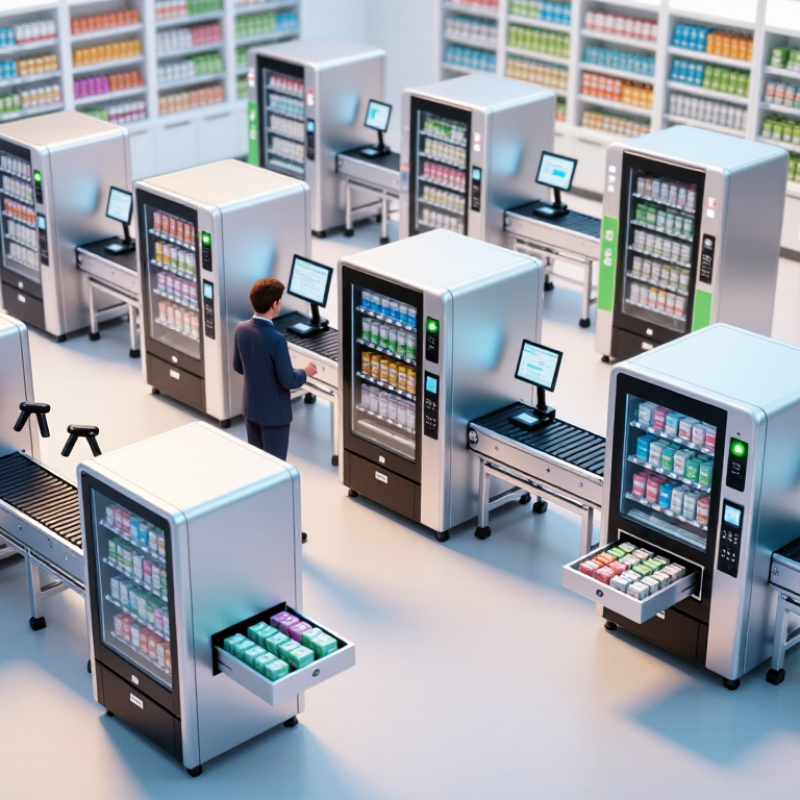
Automated dispensing equipment is a controlled system that stores, identifies, and releases medicines or supplies with limited manual handling. It may include automated dispensing cabinets, carousel units, robotic picking systems, barcode scanners, and inventory software. In a hospital pharmacy, a nurse selects an approved item, scans the patient order, and receives a specific drawer location. The system records access, quantity, time, and user identity.
The definition is not perfectly clean. Some systems only control storage, while others combine dispensing, counting, labeling, and restocking. ASHP’s 2023 National Survey reported automated dispensing cabinets in roughly nine out of ten surveyed hospitals, showing their practical importance in medication distribution. Grand View Research’s 2024 Pharmacy Automation Market report also estimated the global market in the multi-billion-dollar range, with continued growth through 2030. These figures reflect demand, not guaranteed safety. Poor data entry, incorrect stock settings, or skipped barcode checks can still create risk. Machines reduce repetitive work. They do not replace professional judgment. Reliable deployment requires workflow mapping, staff training, access controls, maintenance records, and regular inventory reconciliation. A useful evaluation should examine refill speed, discrepancy rates, uptime, and error-reporting quality, rather than focusing only on purchase price. In practice, the best equipment often feels uneventful: the correct item appears, the audit trail is clear, and unusual activity is noticed quickly.
When evaluating automated dispensing equipment manufacturers, treat market growth as context, not proof of quality. Grand View Research and Fortune Business Insights place the 2023 global pharmacy automation market near US$5–7 billion. Their estimates differ because product definitions vary. Ask what each figure includes: cabinets, robotics, software, or service contracts. A polished demonstration can hide difficult replenishment work.
Test equipment inside your real workflow. Measure picking accuracy, dispensing speed, jam frequency, uptime, and mean time to repair. Request customer references with similar volumes and staffing levels.
The 2023 ASHP National Survey of Pharmacy Practice reports widespread use of automated dispensing cabinets in hospitals, but adoption alone does not prove safe integration. Check interoperability with pharmacy systems, barcode controls, audit trails, and emergency procedures. Small delays become visible during a night shift.
Cybersecurity deserves equal attention. IBM’s 2024 Cost of a Data Breach Report placed the average healthcare breach cost at US$9.77 million. Ask manufacturers to explain patch schedules, access controls, encryption, vulnerability disclosure, and offline recovery. NIST Cybersecurity Framework 2.0 offers a useful evaluation structure. Service promises need evidence. Review response-time records, spare-parts availability, training quality, and total ownership costs over seven years. I would still run a limited pilot. No scorecard is perfect, and a low purchase price can conceal expensive workflow changes.
The top 10 automated dispensing equipment manufacturers should be judged by performance, safety, and service depth. A strong manufacturer builds systems that dispense accurately during repetitive, high-volume work. Reliable equipment may include barcode verification, modular storage, robotic picking, and real-time inventory tracking. In practice, small details matter. A smooth drawer, clear screen, or quiet motor can reduce daily operator fatigue.
Leading manufacturers usually support different workflows, including pharmacies, laboratories, warehouses, and production facilities. Their systems should handle varied package sizes without frequent manual adjustments. Look for measured dispensing accuracy, documented cycle times, and simple maintenance access. A stainless-steel frame is useful in demanding environments. Remote diagnostics can also shorten downtime, although connectivity is not always perfect. Claims should be checked against independent testing and customer references.
Tips: Ask for a live demonstration using your own containers. Review error logs, cleaning procedures, software training, and spare-part availability. Check whether the system integrates with existing inventory software. A low purchase price may become expensive when service response is slow. We should admit one weakness: no ranking fits every facility. A compact unit may suit a small operation, while a larger site needs multiple machines and stronger integration. Evaluate the full operating cost, not only the equipment quote.
The top ten automated dispensing equipment manufacturers compete through precision, uptime, and practical integration.
Their systems combine robotic arms, barcode readers, machine vision, and inventory software. These technologies reduce picking errors and reveal stock movement in real time. A well-designed unit can identify a package, confirm its location, and dispense it within seconds.
Applications vary across hospitals, pharmacies, laboratories, and distribution centers. In hospitals, secure cabinets support controlled access and faster medication retrieval. In pharmacies, robotic modules count, label, and organize routine orders. Laboratories use refrigerated dispensing systems for temperature-sensitive samples. Distribution centers often connect automated storage equipment with warehouse management platforms.
Reliable manufacturers also provide calibration records, access logs, alarm controls, and staff training. These details matter during audits and daily troubleshooting.
Integration remains a difficult area. Legacy software may not exchange data cleanly with newer equipment. That weakness can create delays, even when the machine itself performs well. Human verification is still valuable for unusual packaging, damaged labels, or urgent exceptions.
Sensor redundancy, preventive maintenance, and clear recovery procedures improve operational safety. Yet automation is not automatically efficient. Poorly measured workflows can simply move bottlenecks from a counter to a conveyor.
Experienced buyers should test real package sizes, peak-hour demand, cleaning routines, and failure recovery before approval. Performance claims deserve independent validation. The best equipment is not always the fastest. It is the system that remains accurate, traceable, and usable under pressure.
Choosing an automated dispensing equipment manufacturer requires more than comparing purchase prices. Start with product accuracy, throughput, software integration, and service response. Site evaluations often reveal hidden issues, such as noisy conveyors, difficult cleaning, or limited storage access. These details affect staff performance every day.
The International Federation of Robotics reported 541,302 industrial robot installations worldwide in 2023. This growth shows stronger demand for dependable automation, but higher automation also increases integration risks. Ask manufacturers for verified accuracy rates, uptime records, error-recovery procedures, and customer references in similar facilities. Request a live demonstration using products similar to yours. A polished showroom test may not represent peak-hour conditions. That weakness deserves attention.
Tips: Build a scoring sheet before contacting suppliers. Include equipment capacity, barcode or software compatibility, training, spare-parts availability, cybersecurity controls, and total ownership cost. Check whether technicians are locally available. Review the warranty language carefully. Also, calculate the cost of downtime, not only the equipment price. A cheaper system may become expensive after repeated service delays. Avoid relying on one impressive case study. Independent testing data is more useful. Metrics can still mislead without operating context.