
Injection molding automation is reshaping how manufacturers handle repetitive, precision-sensitive work. Robots remove finished parts, sprues, and runners; conveyors and vision systems then support consistent downstream handling. On a busy factory floor, even a few seconds saved per cycle can matter. But speed alone does not make a production line dependable.
The International Federation of Robotics reported 541,302 industrial robot installations worldwide in 2023 in its World Robotics 2024 report. China accounted for 276,288 installations, or about 51% of the global total. These figures cover industrial robots across sectors, not injection molding alone. They nevertheless show the scale of China’s robotics ecosystem and its relevance to manufacturers exploring automation.
This guide examines top China injection molding automation manufacturers and the capabilities buyers should assess. Look beyond promotional claims. Compare robot payload, reach, cycle-time compatibility, controller integration, safety features, service coverage, and spare-parts availability. Ask how a system handles a specific part, mold layout, and machine interface. Details matter.
The best supplier is not always the one with the largest catalog. A well-matched take-out robot may outperform a more elaborate cell that operators struggle to maintain. That is easy to overlook. Published market figures also cannot confirm a vendor’s real-world quality. Factory references, documented acceptance tests, and clear technical support deserve close attention. Automation can reduce handling variation, but setup and process discipline still matter. Some installations take more adjustment than expected. This comparison offers a practical starting point, not a substitute for checking each manufacturer against your production needs.
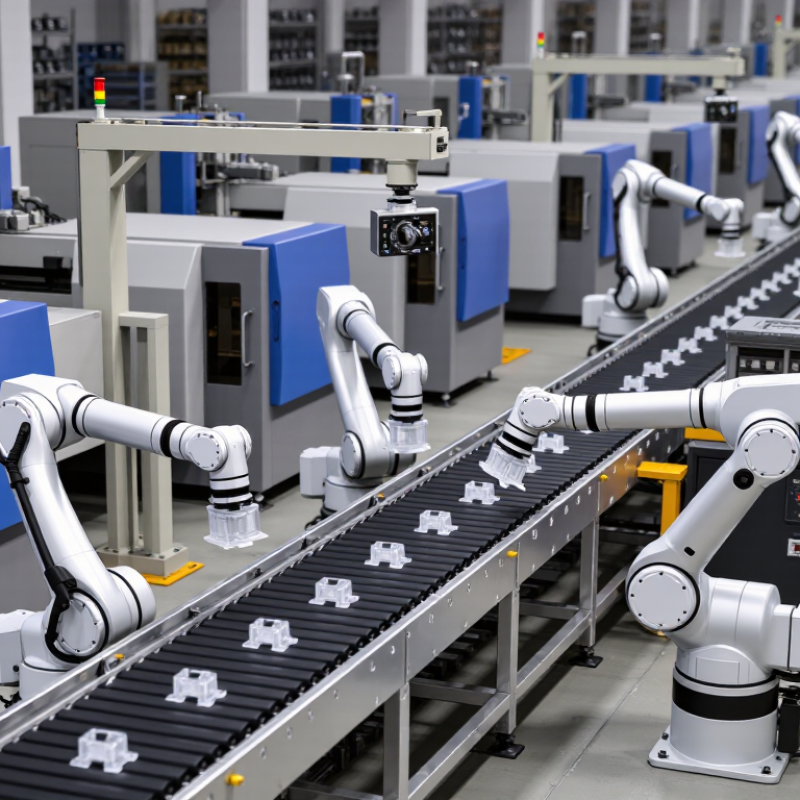
Top China Injection Molding Automation Manufacturers
Injection molding automation manufacturers produce more than robots. They build equipment that moves parts from the mold, separates runners, and carries finished pieces to inspection or packaging. Common products include take-out robots, sprue pickers, conveyor belts, and custom end-of-arm tooling. A robot may lift a warm plastic part with a shaped gripper while avoiding nearby mold surfaces. Small clearances matter.
Many manufacturers also supply material dryers, loaders, dosing units, and centralized controls. These systems help keep resin ready and deliver it to the machine in measured amounts. For quality checks, a production cell may include cameras, sensors, or simple go/no-go gauges. A camera can spot a short shot or misplaced insert, but lighting and part color affect results. That needs testing.
Some suppliers design complete cells, combining robots, safety fencing, conveyors, and machine interfaces. Others focus on individual components or retrofit older equipment. Buyers should check cycle-time data, payload limits, service access, and compatibility with existing machines. A cell can look tidy in a showroom yet need careful adjustment on a crowded factory floor. That detail is easy to underestimate.
China’s injection molding automation industry is structured as a connected supply chain, not a single category of factory. Some manufacturers focus on take-out robots, conveyors, and part handling. Others build end-of-arm tools, safety systems, vision inspection, or production data software. System integrators combine these components with molding machines, dryers, and downstream packaging equipment.
The divisions are useful, but they are not always clean. A supplier may design a robot and also provide installation, while an integrator may modify fixtures for a specific mold. It is fragmented. Buyers should look beyond equipment lists. Ask who programs the cell, tests it with the actual part, and responds when a gripper slips or a sensor misreads a dark surface. These details reveal practical capability.
Regional supplier networks can shorten access to machining, electrical parts, and service technicians, though support quality still varies. A technically sound cell depends on cycle-time balance, guarding, communication protocols, and repeatable part placement. Small changes matter. A heavier insert or a two-second cooling shift can disrupt an entire line. Factory visits and sample trials provide stronger evidence than broad claims, yet even a successful trial may not reproduce every production condition. That limitation deserves honest discussion.
How China’s Injection Molding Automation Industry Is Structured
China’s injection molding automation ecosystem includes robot suppliers, machine builders, molders, and integrators. Annual industrial robot installations offer a broader indicator of the automation environment—not a count of robots used specifically in injection molding. Figures: International Federation of Robotics (IFR), World Robotics.
Key Technologies Used in Injection Molding Automation
Injection molding automation is more than a robot beside a press. It connects machine controls, take-out robots, end-of-arm tooling, vision inspection, conveyors, and part tracking. Cartesian robots often suit repetitive part removal; six-axis robots offer more flexibility for insert handling and trimming. The right choice depends on mold layout, cycle time, payload, and access—not speed alone. Small details matter.
The International Federation of Robotics reported 541,302 industrial robot installations worldwide in 2023, with the operating stock reaching 4.28 million. These figures cover all industries, not injection molding alone, but show the wider scale of industrial automation. Servo-driven movement and feedback controls support repeatable handling. Grippers or vacuum cups must match each part’s shape and surface. Vision systems can detect flash or color variation, yet reflections and poor lighting may trigger false rejects. This is easy to underestimate.
Deloitte’s 2024 Smart Manufacturing Survey found that 86% of respondents expected smart manufacturing to drive competitiveness within five years. In a molding cell, connected press, robot, and inspection data can help teams track cycle time, alarms, and scrap. Still, integration is rarely plug-and-play. Legacy controls and misplaced sensors can produce misleading readings. Test one cell first, and verify results across different shifts.
| Technology | Primary Function | Typical Equipment or Components | Key Control or Data | Common Applications |
|---|---|---|---|---|
| Automated part removal | Removes molded parts from the mold area and transfers them to the next process. | Cartesian take-out robots, articulated robots, grippers, and end-of-arm tooling. | Robot position, motion sequence, pick confirmation, and cycle coordination with the molding machine. | Part extraction, sprue removal, sorting, and placement on a conveyor or fixture. |
| End-of-arm tooling (EOAT) | Grips or supports parts during removal and transfer while limiting surface damage. | Vacuum cups, mechanical fingers, pneumatic grippers, and custom fixtures. | Grip status, vacuum level or pressure, and tool-position feedback where fitted. | Handling parts with different shapes, surface finishes, and stiffness. |
| Part transfer and conveying | Moves parts between molding, inspection, assembly, and packing operations. | Belt conveyors, indexing tables, chutes, part separators, and transfer fixtures. | Part presence, transfer timing, accumulation, and routing signals. | Continuous production lines and work cells with downstream operations. |
| Machine vision and inspection | Checks visible part features and supports automatic sorting or process alerts. | Industrial cameras, lenses, lighting, image-processing systems, and reject mechanisms. | Image-based pass/fail results, feature measurements, and defect classifications configured for the part. | Presence checks, orientation verification, color or surface checks, and dimensional inspection of visible features. |
| Process monitoring and machine integration | Coordinates automation with the molding machine and records selected production signals. | Machine controllers, PLCs, sensors, operator interfaces, and production-data systems. | Cycle status, alarms, machine-ready signals, production counts, and configured process values. | Cell sequencing, fault response, traceability, and production monitoring. |
| Automated mold and setup changeover | Helps reduce manual setup work when changing molds or production recipes. | Mold clamps, locating systems, quick connectors, and stored setup parameters. | Clamp status, connection checks, mold identification where implemented, and recipe selection. | High-mix production and facilities that run multiple mold configurations. |
| Safety and cell protection | Protects personnel by controlling access to hazardous machine and robot areas. | Safety guards, interlocked gates, light curtains, emergency stops, and safety controllers. | Guard status, access events, emergency-stop signals, and safety-system diagnostics. | Robot cells, automated mold areas, and integrated production lines; safeguards should be selected through a machine risk assessment. |
Technology configurations and available functions vary by machine, part, mold, and production-cell design.
When evaluating Chinese injection molding automation manufacturers, look beyond machine speed and catalog claims. Check whether the supplier has completed projects for parts similar to yours, including comparable materials, tolerances, and production volumes. Ask engineers to explain robot reach, mold-change access, and how parts move from the machine to inspection or packaging. Request cycle-time figures with operating conditions clearly stated. Brochures are not proof.
Tips: Bring a sample part, mold layout, and target output to technical discussions. Ask for a written integration scope, sample safety documentation, and a factory acceptance test plan. Note who answers detailed questions. That matters.
Inspect the proposed cell layout for practical details: cable routing, operator access, guarding, and room for maintenance tools. Ask how faults are logged and whether alarms identify a clear next action. Confirm spare-parts availability and typical service response times for your region. If possible, speak with a customer running a similar cell and ask what needed adjustment after installation. One reference is not a complete picture, though. I would compare several. A polished demonstration may not reflect your actual resin, mold, or shift pattern, so arrange a trial using your production conditions before making a decision.
Injection molding automation serves automotive, medical, electronics, and packaging producers. Each sector demands a different balance of speed, precision, and traceability. Automotive suppliers often automate part removal and inspection; medical plants prioritize clean handling and consistent records. Small details matter: a gripper that marks a clear plastic lens can turn a fast cycle into scrap.
Market signals point to continued investment. The International Federation of Robotics reported 541,302 industrial robot installations worldwide in 2023, with China accounting for 276,288. These figures cover industrial robots broadly, not injection molding alone, but they show the scale of automation demand. Plastics Europe’s Plastics—The Fast Facts 2024 estimates global plastics production at 413.8 million tonnes in 2023. More output brings pressure to reduce waste, energy use, and manual handling. Vision inspection and connected process monitoring are gaining attention, though integration can be uneven. A dashboard is not useful if operators cannot act on its alarms.
Tip: Match the automation cell to the part and mold. Check robot reach, cycle time, changeover needs, and access for maintenance. Ask suppliers for measured results from similar applications, not just theoretical cycle-time claims. Small pilots help. They also reveal overlooked bottlenecks, such as cooling delays or inconsistent part release.
