What Are the Top Flange Accessory Types in 2026?
In 2026, choosing the right Flange Accessory remains essential for a dependable, leak-resistant pipe connection. The most common options include gaskets, bolts and nuts, washers, insulation kits, orifice plates, and line blanks such as blind flanges and spectacle blinds. Each serves a different purpose. A gasket seals the joint, while correctly sized fasteners provide the clamping force that keeps it secure.
The best choice depends on more than popularity. Operating pressure, temperature, fluid compatibility, flange dimensions, and maintenance needs all affect suitability. For example, a gasket selected for a hot steam line may not suit a process carrying corrosive chemicals. Insulation kits can help limit electrical current across a joint, while orifice plates support flow measurement. Small details matter. Even a mismatch in bolt length or gasket inner diameter can complicate installation or weaken performance.
This guide looks at the leading flange accessory types and explains where each is commonly used. It also highlights practical selection checks, including material data, equipment specifications, and supplier documentation. Product names and configurations can vary, so a “top” accessory is not automatically the right one for every system. The category is less tidy than many buying guides suggest. Real installations may involve trade-offs, and specifications should be checked against the actual service conditions before purchase or replacement.
What Flange Accessories Are and How They Support Piping Systems
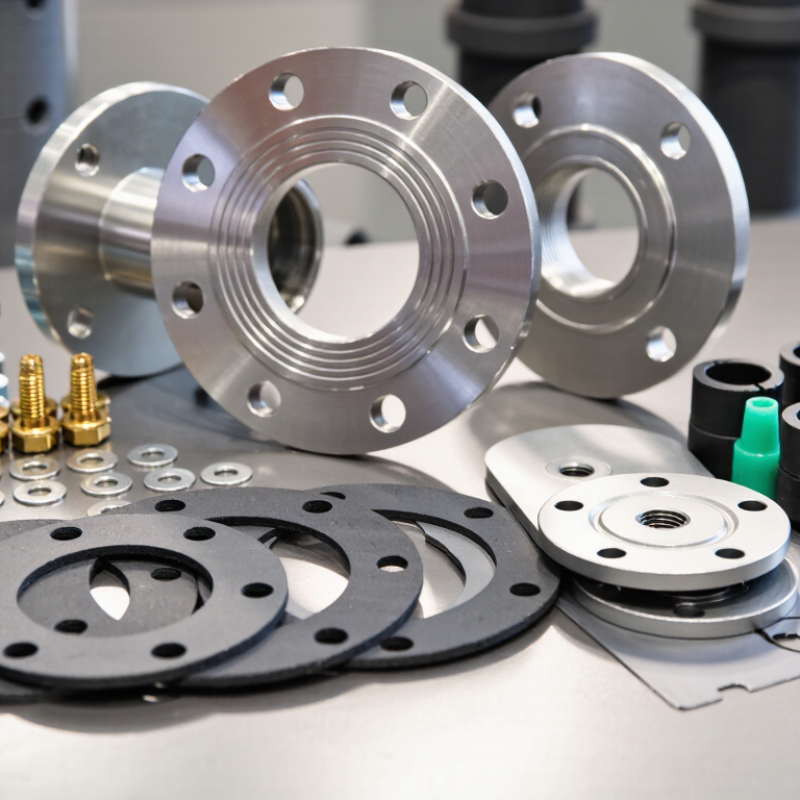
Flange accessories are the parts that help a flanged joint seal, stay aligned, and work as intended. They include gaskets, bolts, nuts, washers, and insulating kits. Some piping layouts also use blind flanges, spacers, or spectacle blinds to close, separate, or control access to a line. The exact selection depends on the joint and service conditions. Small parts matter.
A gasket sits between the flange faces and helps prevent leakage. Bolts and nuts provide the clamping force that holds those faces together; washers can help distribute load. An insulating kit separates connected flanges electrically, which may be needed to limit current transfer or corrosion in specific systems. These parts work as a set. A suitable gasket cannot compensate for uneven tightening or damaged flange faces.
Choosing accessories means checking pressure, temperature, fluid compatibility, flange dimensions, and the applicable piping specification. A mismatch can cause leaks, difficult maintenance, or premature wear. During installation, inspect the sealing surfaces and tighten bolts in a controlled sequence using the project’s procedure. This step is sometimes rushed, and it shows. Even the right materials may perform poorly when alignment or tightening is overlooked. Verify requirements with qualified engineering or maintenance personnel for the specific system.
How Flange Accessories Are Classified by Function
What Are the Top Flange Accessory Types in 2026?
How Flange Accessories Are Classified by Function
Flange accessories are easiest to classify by the job they perform. Sealing components include gaskets and ring-joint rings, which sit between mating faces to limit leakage. Fastening components—stud bolts, nuts, and washers—maintain the clamping force. Insulating kits separate conductive flanges, while guards help shield workers from hot surfaces or spray. Alignment tools and spacers support installation and fit-up. These functions often overlap in real projects. A gasket can be correctly specified yet fail if the faces are misaligned. Grand View Research estimated the global industrial valves market at USD 77.5 billion in 2023; this figure covers valves, not flange accessories, but shows the scale of equipment reliability needs.
Tip: Match each accessory to pressure, temperature, fluid, and flange-face details. Check the applicable dimensional standard and supplier documentation before ordering. Small mismatches matter.
For maintenance teams, classify parts by failure risk as well as function. Seals address leakage; bolting addresses joint retention; insulation kits address electrical continuity. Keep material certificates and installation records with the asset file. One practical limitation: catalogs do not always group accessories consistently. Verify the actual duty, not just the product category.
Which Gasket Types Provide Flange Joint Sealing in 2026?
For flange-joint sealing in 2026, gasket choice starts with the service conditions, not the catalog. Compressed-fiber, PTFE, and elastomer sheet gaskets suit many lower-pressure duties, but chemical compatibility and temperature limits must be checked. Spiral-wound gaskets combine metal windings with a soft filler, helping them handle changing loads and temperatures. Ring-type joints are designed for high-pressure service with matching grooved flanges. Small details matter. Flange-face finish, alignment, and bolt load can make a suitable gasket leak.
ASME B16.20 covers metallic gaskets, while ASME B16.21 covers nonmetallic flat gaskets; ASME PCC-1 provides guidance for bolted-joint assembly. These standards help define the hardware, but they do not replace application-specific selection. A Fortune Business Insights 2024 report valued the global gaskets and seals market at USD 69.4 billion in 2024, forecasting USD 104.2 billion by 2032. That growth reflects broad demand, not proof that one gasket type fits every joint. In practice, spiral-wound, kammprofile, and jacketed designs may each work well when flange condition and operating data support them. I’d still question a selection based on pressure alone. Temperature cycling, fluid chemistry, and uneven bolt tightening can change the result.
Which Fastening, Isolation, and Protection Accessories Are Common?
Common flange accessories fall into three practical groups: fastening, isolation, and protection. Fasteners include studs or bolts, nuts, and hardened washers. Match their material, diameter, and length to the flange and service conditions. ASME B16.5-2020 covers pipe flanges from NPS ½ through NPS 24 and pressure classes 150 through 2500. That range makes exact class and size checks essential; a near match is still a mismatch.
Gaskets seal the joint, while isolation kits add a gasket, sleeves, and insulating washers to limit electrical contact between dissimilar metals. ASME B16.20-2023 specifies metallic gasket dimensions and types for pipe flanges. For installation, ASME PCC-1-2022 provides guidance on bolted flange joint assembly, including controlled tightening practices. In the field, clean faces and even bolt loading matter. Small details count.
Protection accessories include flange covers for storage, splash guards for leak containment, and shields around exposed connections. They serve different purposes, so a splash guard should not be treated as a pressure-retaining seal. Check fluid compatibility, temperature, and inspection access before fitting one. A cover left in place too long can hide corrosion. It happens.
How to Match Flange Accessories to Operating Conditions
What Are the Top Flange Accessory Types in 2026?
How to Match Flange Accessories to Operating Conditions
Choose flange accessories around the service conditions, not just the pipe size. For hot, high-pressure lines, a correctly specified metallic gasket and compatible bolting help maintain joint integrity through temperature cycles. ASME B16.20 covers metallic gasket dimensions, while ASME PCC-1 provides guidance for bolted flange-joint assembly. For corrosive fluids, check both gasket and fastener materials against the fluid and flange metallurgy. It’s easy to overlook the bolts. That can be costly.
Isolation needs call for different hardware. A blind flange provides a fixed closure; a spectacle blind or spacer can support planned line isolation when the system design allows it. In electrically dissimilar piping, an insulating gasket kit may help limit galvanic corrosion. The NACE IMPACT study estimated corrosion costs at US$2.5 trillion globally, or 3.4% of global GDP, in 2013. That figure is not a prediction for one pipeline, but it underscores why material compatibility matters. Conditions can change, too; verify pressure, temperature, cycling, and maintenance access before final selection.
Tips: Confirm the actual operating envelope, not only the design point. Check gasket seating surfaces and bolt lubrication during assembly. If field conditions are uncertain, pause and review the specification rather than guessing.
What Are the Top Flange Accessory Types in 2026?
Match accessories to the service: select gaskets for pressure, temperature, and fluid compatibility; bolting for load and temperature; insulating kits where electrical or galvanic isolation is needed; spectacle blinds for positive isolation; and orifice plates for flow measurement. Bars count accessory types in this guide, not market share. Verify materials, dimensions, and ratings against the applicable piping specification and operating conditions.