
Automated Dispensing Robot Videos
A World of Robotic Dispensing and Assembly SolutionsWhat Are the Top Types of Flat Bar Grating?
Flat Bar Grating is used for walkways, platforms, stair treads, and drainage covers where open space and dependable support matter. Yet “top type” depends on the job. A wet plant floor, a rooftop service path, and a loading bay place different demands on load capacity, corrosion resistance, and foot traffic. The details matter.
Common options include welded, press-locked, swage-locked, and riveted grating. Welded panels suit many general industrial applications, while press-locked designs offer a smooth, uniform appearance. Swage-locked construction mechanically secures cross bars; riveted grating can be useful where vibration or heavier service is a concern. Stainless steel and aluminum are material choices, not joining methods, and should be compared separately. A practical caveat: suppliers do not always use these labels consistently.
Reliable selection starts with documented loads, bearing-bar size and spacing, span, finish, and support conditions. NAAMM’s Metal Bar Grating Manual, MBG 531, provides technical guidance and load tables for evaluating grating; actual panel capacity still depends on its specifications and installation. For workplace surfaces, OSHA’s walking-working-surface standard also emphasizes maintaining safe conditions, including addressing hazards such as wet or damaged surfaces. Industry context is broader: World Steel Association’s World Steel in Figures 2025 reports 1,882.6 million tonnes of crude steel production worldwide in 2024. That figure reflects steel production, not grating demand. This guide compares the leading types by construction, performance, and practical fit, while recognizing that a neat catalog description cannot replace project-specific checks.
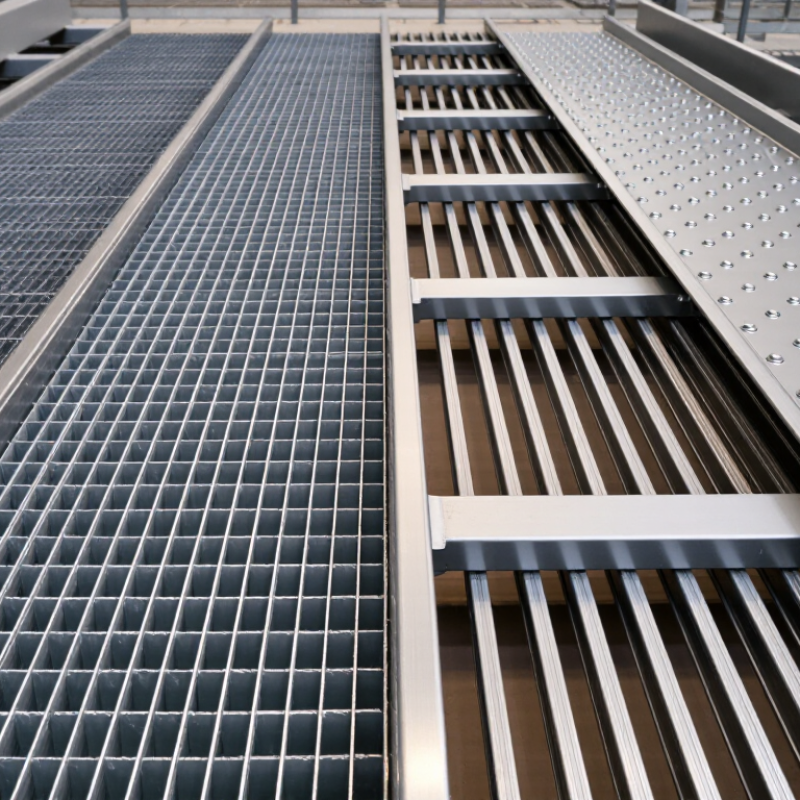
Welded Flat Bar Grating
Welded flat bar grating joins load-bearing steel bars to perpendicular crossbars through resistance welding, creating a rigid, open panel. The bearing bars carry the main load; crossbars help hold spacing and resist movement. A common 19-W-4 pattern places bearing bars 1-3/16 inches apart and crossbars 4 inches apart. These dimensions are useful reference points, not a substitute for checking the required span and load.
NAAMM’s Metal Bar Grating Manual, MBG 531, provides load tables that relate grating capacity and deflection to bar size, spacing, and span. That matters on a real walkway: a panel spanning a wide gap needs a different specification than one supported every few feet. Specify the actual clear span, expected pedestrian or equipment load, and bearing-bar direction before ordering.
Check the panel edges, too. A tight fit looks neat, but installation tolerances and support details can complicate it.
For outdoor or wet locations, specify a suitable corrosion-protection finish and inspect welds and cut edges during installation. A small mismatch in bar depth can affect fit and performance.
Mistakes happen.
FAQS
It joins load-bearing bars to perpendicular crossbars by resistance welding. The bearing bars carry most of the load.
Bearing bars are 1-3/16 inches apart, with crossbars spaced 4 inches apart. Treat these as reference dimensions, not a final specification.
Check the clear span, expected pedestrian or equipment load, and bearing-bar direction. A panel over a wide gap needs a different specification.
Crossbars are pressed into slots in the bearing bars, creating a close-fitting grid. A neat appearance alone proves nothing.
It can suit walkways, platforms, and drainage areas. Open spaces let water and light pass through.
Rivets connect the bars at each intersection, while bearing bars carry most of the applied load. Fine debris may collect at intersections.
They may add grip, but footwear, drainage, and site conditions still matter. Grip is not the whole story.
Confirm load data, support spacing, panel fit, and suitable corrosion protection for wet or outdoor locations. Inspect welds and cut edges, too. Small mismatches happen.