Automated Dispensing Robot Videos

A World of Robotic Dispensing and Assembly Solutions

How to Choose a Robotic Filling Machine?

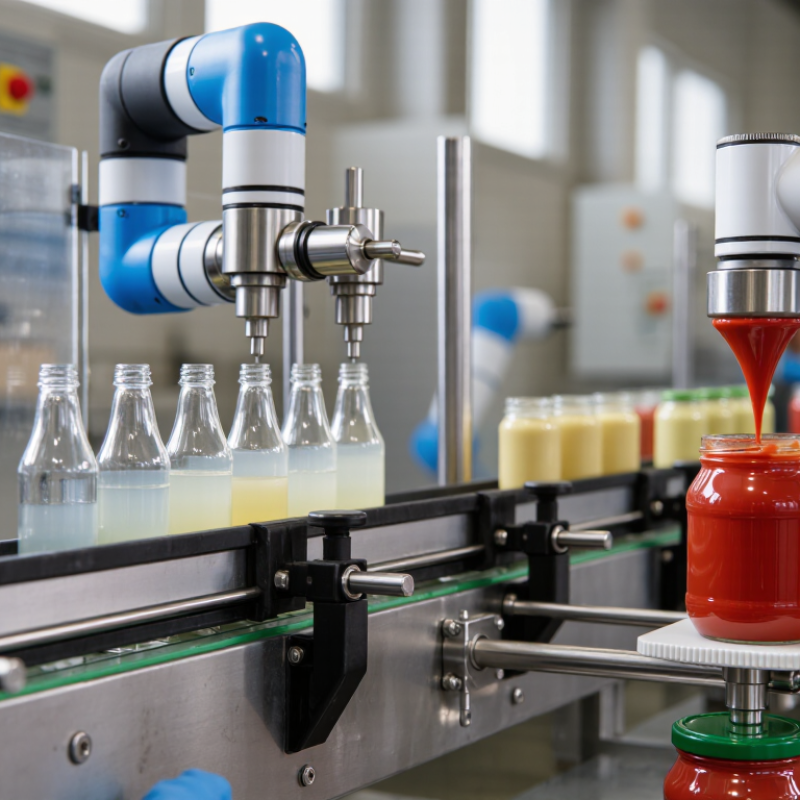
Choosing a Robotic Filling Machine is not simply a question of speed. The right system must suit the product, container, and production environment. A thin beverage may splash through a wide-neck bottle, while a viscous sauce can cling to a nozzle. These details affect accuracy, cleaning, changeovers, and downtime. Small tests matter.

The International Federation of Robotics’ World Robotics 2024 report recorded 4.28 million industrial robots operating worldwide in 2023, up 10% from the previous year. That figure reflects broad industrial adoption, not filling-machine performance. Still, it shows why buyers should examine real operating data, not just promotional cycle speeds. IFR President Marina Bill described the preceding year’s growth this way: “In 2022, the number of industrial robots installed worldwide climbed to 553,052 units. This is the highest number of installations ever recorded in one year.” (IFR, World Robotics 2023.)

Before comparing models, define the target fill volume, container range, required output, and acceptable product loss. Ask suppliers to demonstrate your actual product in your actual packaging. Watch for drips, foam, and awkward changeovers. Then check whether operators can reach valves and nozzles without dismantling half the line. A specification sheet may look reassuring. It can still miss a stubborn cap or a bottle that tips on the conveyor. Selection is partly technical—and partly an honest review of what your production floor can handle.
How to Choose a Robotic Filling Machine?

Define Production Requirements for a Robotic Filling Machine

How to Choose a Robotic Filling Machine?
Define Production Requirements for a Robotic Filling Machine

Start with the product and the numbers. Record each container type, fill volume, target output per hour, and planned operating shifts. Note whether the product foams, drips, or changes viscosity with temperature. A thin liquid may need different dosing and nozzle control than a thick sauce. Measure the available floor space, conveyor height, and time operators can spend changing formats.

Set a realistic output target using actual demand, not a best-case estimate. The International Federation of Robotics reported 4.28 million industrial robots operating worldwide in 2023, up 10% from 2022. That figure, from World Robotics 2024, shows wider industrial adoption; it does not predict filling-line performance. Ask suppliers to test your product and containers at the required speed, then check fill accuracy, rejects, and cleanup time. The test matters.

Plan for changeovers and interruptions. If the line runs several container sizes, record how often formats change and how long each changeover can take. Specify cleaning steps, operator access, and the space needed for maintenance. One detail is easy to miss: a fast machine can still limit output if upstream containers arrive unevenly. Build in a buffer, but verify it against the actual line layout. Estimates can be wrong. Keep the assumptions visible, and revisit them after a production trial.

How to Choose a Robotic Filling Machine: Define Production Requirements

Estimate hourly output from container size and target filling speed. These illustrative figures assume continuous operation with no downtime: liters per hour = fill volume (liters) × containers per minute × 60. Actual output depends on the product, filling heads, changeovers, cleaning, and line availability.

Planning takeaway: Set your required containers per minute and fill size first, then confirm that the machine can meet the target with your actual product and operating conditions.

Match Filling Technology to Product and Container Characteristics

A robotic filling machine should be matched to the product before the robot is selected. Thin liquids usually suit gravity or flow-meter filling; thick sauces and creams often need piston or positive-displacement systems. Products with particles require wider product paths and gentle handling. A test with the actual product matters. Viscosity can change with temperature, and a sample that pours well in the lab may behave differently on a cool production floor.

Container details matter just as much. A narrow-neck bottle needs accurate nozzle positioning and splash control, while an open tub may allow faster filling but require careful drip management. Check container height, opening diameter, material, and stability under the filling head. PMMI’s 2022 State of the Industry report recorded U.S. packaging machinery shipments of $10.5 billion in 2021, up 7.2%. That growth signals investment, not one best filling method for every line.

During trials, record fill weight, cycle time, foam, drips, and changeover time. Run several container sizes, not just the easiest one. A servo-driven piston can provide repeatable portions for viscous products, but cleaning access may be less convenient than expected. That trade-off deserves a close look. Ask operators to test nozzle clearance and container handling at real line speed; small misalignments become obvious quickly.

Compare Robot Types, Reach, Payload, and Filling Configurations

How to Choose a Robotic Filling Machine?

Compare robot types, reach, payload, and filling configurations against the actual container and production layout. Cartesian robots suit predictable, straight-line movements. SCARA robots can move quickly across compact work areas. Articulated robots reach around fixtures, while delta robots handle lightweight items at high speeds. Each type has limits. A fast robot may not fit a crowded cell.

Measure the full working area, not just the distance between the robot and the bottle. Include guards, conveyors, hoses, and space for cleaning or maintenance. Check payload with the gripper, nozzle assembly, and filled container included. A small tool can add more weight than expected. Choose whether the robot moves containers beneath fixed nozzles or carries nozzles to containers. Single-nozzle setups offer flexibility; multi-nozzle arrangements may support higher output but need careful spacing and drip control. The best choice is rarely the one with the biggest specifications.

Tips: Test the reach using your largest and smallest containers. Confirm payload and wrist-load limits with the supplier. Run a fill trial with the real product; its flow and foaming behavior can change the required speed. Leave room for adjustment. That detail is easy to miss.

How to Choose a Robotic Filling Machine? — Compare Robot Types, Reach, Payload, and Filling Configurations
Robot type Typical reach or working envelope Typical payload range Motion and positioning characteristics Common filling configurations Best suited to Key selection considerations
SCARA Approximately 400–1,000 mm arm reach; varies by model. Approximately 1–20 kg; check whether the rating includes end-of-arm tooling. Fast horizontal motion with vertical-axis movement; generally well suited to repeatable pick-and-place tasks on a flat work surface. Pick containers from an indexing conveyor and present them to a fixed filling nozzle; load and unload containers at a rotary index table. Compact, high-throughput lines with a predictable container path and limited need for angled access. Confirm access to the container opening, conveyor height, cycle time, and whether the tool can avoid neighboring containers and guards.
Six-axis articulated Approximately 500–2,000 mm reach; the usable work area depends on mounting and joint limits. Approximately 3–30 kg for many compact and mid-size applications; larger models are available. Six rotary axes allow the tool to approach from varied directions and change orientation around fixtures or obstacles. Move containers beneath a fixed nozzle; position a dispensing head over stationary containers; serve multiple filling or capping stations. Flexible lines, complex layouts, multiple stations, or processes that need varied approach angles. Check reach at every station, wrist payload and inertia limits, mounting position, collision clearances, and washdown or chemical-protection requirements.
Delta (parallel robot) Typically a compact-to-medium working envelope, often around 300–1,600 mm across, depending on design. Often approximately 0.5–8 kg; allowable payload and speed vary substantially by model. Very fast pick-and-place motion in a primarily overhead work area; the tool orientation may be more limited than on a six-axis arm. Pick lightweight empty containers from a conveyor and place them into nests or an indexing system before filling at a fixed station. High-speed handling of lightweight containers where a separate filling station performs the actual dose. Verify the available vertical clearance, container stability, payload at operating speed, and whether the required tool orientation is supported.
Cartesian or gantry Defined by axis strokes rather than arm reach; strokes commonly range from a few hundred millimeters to several meters. Approximately 5–100 kg or more, depending on frame, axis size, and speed requirements. Linear motion along two or three axes provides a rectangular work area and straightforward movement paths. Move a dispensing head over a row of stationary containers; position containers beneath one or more fixed nozzles; serve a grid of filling positions. Regular layouts, large work areas, heavier tooling, or applications needing predictable straight-line motion. Consider frame stiffness, footprint, cleaning access, support structure, nozzle-to-container alignment, and protection of exposed linear guides.
Collaborative robot (cobot) Commonly approximately 500–1,300 mm reach, depending on model. Commonly approximately 3–20 kg; payload ratings include the tool and any carried product or container. Flexible arm with force-limiting features on many models; collaborative operation depends on a documented risk assessment and application setup. Load containers into a compact filling cell; move a dispensing tool between low-speed stations; support changeovers between product formats. Lower-to-medium throughput cells that benefit from flexible layouts or frequent product changeovers. Do not assume the robot is safe to operate without guarding. Assess nozzle hazards, sharp edges, hot surfaces, chemicals, speed, tooling, and the complete work cell.

Figures are indicative selection ranges, not guaranteed specifications. Actual reach, working envelope, payload, speed, accuracy, and hygienic suitability vary by robot model and installation. Size the payload for the complete tool, hoses, fittings, carried container, and dynamic forces. For accurate dosing, select the metering system and nozzle for the product’s viscosity, foaming behavior, temperature, and required fill tolerance; the robot positions equipment or containers but does not by itself determine dosing accuracy.

Assess Accuracy, Hygiene, Safety, and Line Integration

Accuracy starts with the product, not the brochure. Run the intended liquid at its normal temperature and viscosity, then compare fill weights across several speeds. Check the machine’s stated tolerance against your own acceptance limits, and ask how often nozzles need calibration. A few test bottles can hide drift. Use a longer trial.

Hygiene needs visible proof: tool-free product-contact parts, smooth welds, and drainage that leaves no puddles beneath the filling heads. The CDC estimates that 48 million people in the United States get foodborne illnesses each year; that is a strong reason to examine cleaning access and changeover procedures closely. Safety deserves the same practical scrutiny. The U.S. Bureau of Labor Statistics reported 2.8 nonfatal injury and illness cases per 100 full-time workers in manufacturing in 2022. Check guarding, emergency stops, and safe access during jam clearance. Then assess line integration: verify conveyor height, container spacing, controls, and data exchange with upstream and downstream equipment. Ask operators to run a real changeover. I would still question any quoted changeover time until it is tested on your floor.

Evaluate Supplier Support, Operating Costs, and Future Scalability

When comparing robotic filling machines, supplier support deserves the same scrutiny as filling speed. Ask who handles commissioning, operator training, and urgent troubleshooting. Get response-time targets in writing, and check whether technicians can reach your site or provide remote help. A polished demonstration is not a service plan.

Estimate operating costs using your actual shifts, product, and container sizes. Include energy, compressed air, routine maintenance, replacement seals, and changeover labor. Ask for a list of wear parts and their expected replacement intervals. Then compare the estimate with your current filling process. Small details matter. A machine that saves labor may still create costly downtime if one sensor takes weeks to replace.

Think about what may change over the next few years: more container formats, new recipes, or higher output. Confirm the machine can accommodate those changes, and ask what extra tooling or software would cost. Where possible, test your own containers and product during a factory trial. Watch the changeover, not just the steady run. One trade-off is easy to overlook: buying extra capacity now may mean paying for features your team cannot use yet. Conversely, leaving no room for growth can make a later upgrade awkward and expensive.